History of Thammasat University
History of Thammasat University
Thammasat University was founded on June 27, 1934. The university was originally named “University of Moral and Political Sciences” (UMPS). It was established based on the ideas of Professor Dr. Pridi Banomyong, who sought to create a university that emphasized education in democracy. The goal was to provide education and foster understanding of the new political system, which had been established just two years earlier, to a large number of citizens who were eager to learn.
As reflected in the philosophy behind the founding of the university, which was articulated in the speech delivered by Professor Dr. Pridi Banomyong
“…A university can be likened to a well that quenches the thirst of the people who seek knowledge. It is a right and opportunity they deserve, according to the principles of educational freedom…”
For this reason, the University of Moral and Political Sciences was designed as an open learning marketplace, welcoming both high school graduates and working individuals to study without requiring entrance exams. Tuition fees were kept low, teaching materials were published and sold at affordable prices, and students were not required to attend lectures—only to take exams as scheduled. This made it the first open university in Thailand. In its inaugural year, 7,094 students enrolled, most of whom were sons and daughters of non-wealthy families, including a diverse middle class with various professions. The university offered two main fields of study: the Bachelor of Law program and accounting studies.
The symbol of Thammasat University
The Dharma Wheel Emblem is depicted as a golden-yellow Dharma Wheel outlined in red, with a total of 12 spokes. At its center is a red and yellow tray holding the Constitution. Around the edge of the Dharma Wheel, the name “Thammasat University” or its abbreviation “TU” is inscribed in red. The words are positioned with “มหาวิทยาลัยธรรมศาสตร์” (Thammasat University in Thai) or “ม.ธ.” (TU in Thai) at the top and “THAMMASAT UNIVERSITY” or “T.U.” at the bottom, with a red Kanok (traditional Thai pattern) motif separating the two phrases.
The “Dharma Wheel Emblem” symbolizes the university’s commitment to Buddhist principles as a foundation for nurturing its graduates. The central tray holding the Constitution signifies the university’s dedication to upholding and honoring the Constitution, a principle that the institution has consistently adhered to throughout its history.
The university’s colors are yellow and red. The reason behind the selection of these colors is not definitively documented, but it is known that Pridi Banomyong, the university’s founder, chose them. The yellow represents religion, akin to the Dharma Wheel, while the red signifies intensity and blood, as reflected in the lyrics of a song by Khun Wichitmatra: “Our yellow symbolizes the Dharma in our hearts, our red signifies the blood we dedicate.”
The song of Thammasat University
เพลงพระราชนิพนธ์ ยูงทอง
เพลงเงาโดม
เพลงโดมเริงใจ
เพลงขวัญโดม
เพลงโดมในดวงใจ
เพลงสีเหลืองแดง
Place
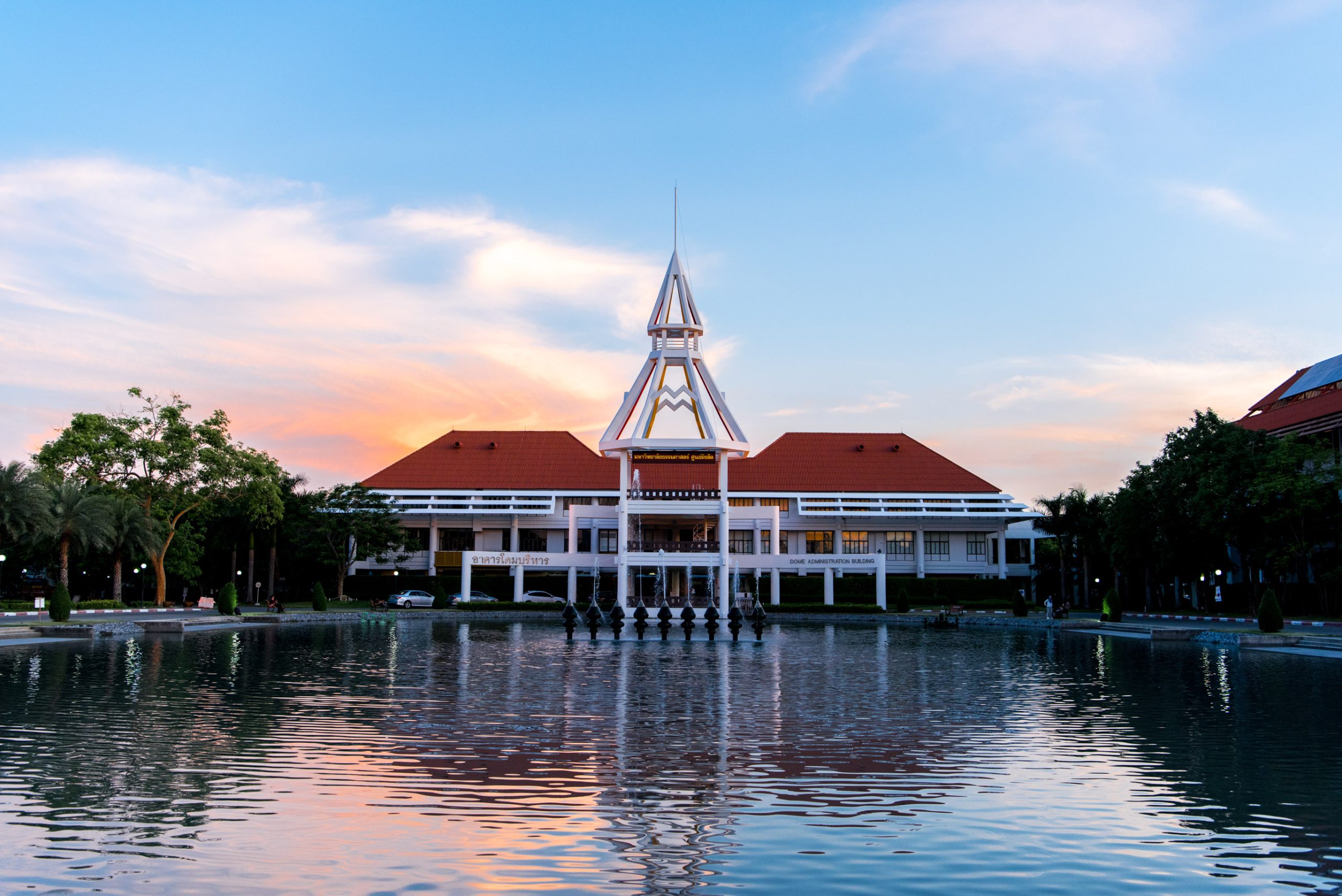
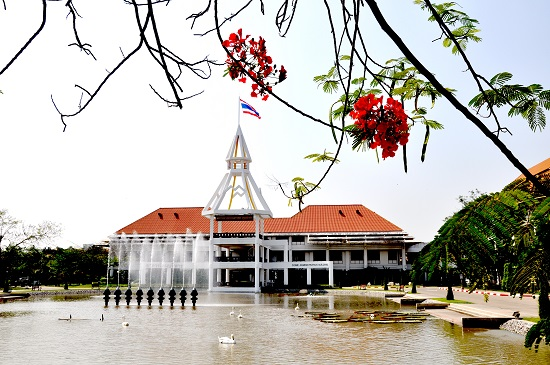
The Dome Building was the first structure of the University of Moral and Political Sciences. It was designed by Jitsen (Mew) Abhaiwongse, following the guidance of key figures at the university. The building was an adaptation of four old barracks belonging to the 4th Infantry Battalion, which were connected to form a single structure. In the center of the building, an additional three-story structure was constructed, with the “Dome” as a central symbol.
The design of the Dome was later explained to have been inspired by an octagonal pencil sharpened to a point, symbolizing the lofty wisdom of education, in line with the vision of Professor Dr. Pridi Banomyong.