
Thammasat Advances as “Well-Being University,” Prioritizing Sustainable Health
TU One Health: Enhancing physical and mental stabilities

The promotion of health to enhance the quality of life for students and staff is one of the important initiatives of Thammasat University. The goal is to make Thammasat a safe space both physically and mentally, fostering sustainable happiness within the community.

Assoc. Prof. Dr. Pharuhat Tor–Udom, Deputy Rector for Administrative Affairs at the Center for Health Sciences, Thammasat University, stated that health care for well-being is not merely about treatment at the endpoint, but rather about promoting sustainable health care and enhancing the capacity for disease prevention before it occurs. Therefore, Thammasat University places significant importance on health promotion alongside health literacy for both students and staff through the implementation of the Good Health University policy, or TU One Health.
“Health literacy is an important matter that universities must undertake to impart to students, enabling them to understand and apply it to promote their own health and that of those around them. This lays a crucial foundation for enhancing the well-being of individuals in society in the future,” he stated.

Under the TU One Health policy, the administration of the Center for Health Sciences has initiated the project “One Health For Future Wellness University,” which focuses on integrating health-related operations based on key principles for the prevention, control, and resolution of systemic health issues. This is achieved through comprehensive health initiatives within the university.
Occupational Safety and Health Committee (OSH) has been established within the organization to centralize information for the management of health promotion at Thammasat University, supporting the effective implementation of TU One Health across the entire organization.
To evaluate the outcomes of these operations, in the year 2025, Thammasat University will undergo its first self-assessment to become a Healthy University through the Healthy University Rating System (HURS), which is a system used to assess and classify “health-promoting universities” to monitor progress in health promotion within higher education institutions. This system has been developed by the ASEAN University Network on Health Promotion (AUN-HPN).
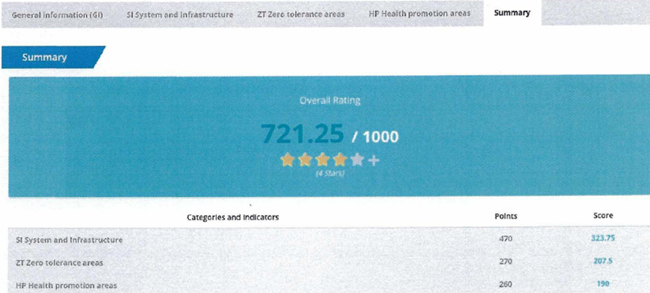
Thammasat University achieved a total score of 725 points out of a possible 1,000 points, representing 72.5%, and is rated at 4 stars. The assessment results are summarized in three areas as follows:
1. System and Infrastructure (SI) – Scoring 68.9%, with the highest scores in the capacity to create health promotion capabilities (87.5) and research in health promotion (83.3).
2. Health Promotion Areas (HA) – Scoring 74.5%, receiving full points for areas related to mental well-being and social interaction, with health literacy scoring at 87.5%.
3. Zero Tolerance Areas (ZA) – Scoring 76.8%, with the highest zero tolerance areas concerning smoking (87.5) and alcohol consumption (87.5).
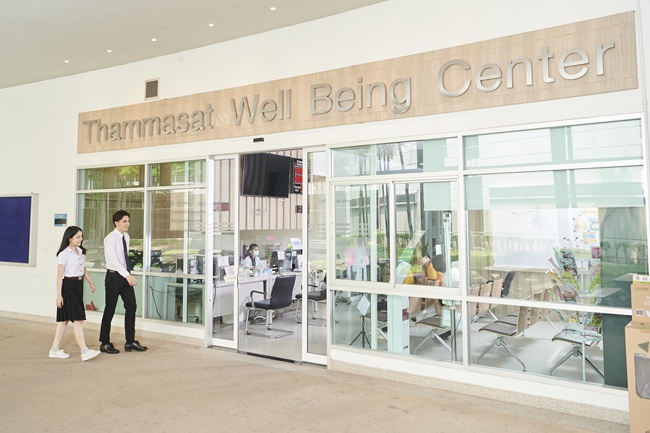
This assessment reflects a portion of the results from the efforts to create a “Healthy University,” demonstrating both strengths and areas for further development to sustainably enhance the well-being of the Thammasat community with standards and tangible outcomes.